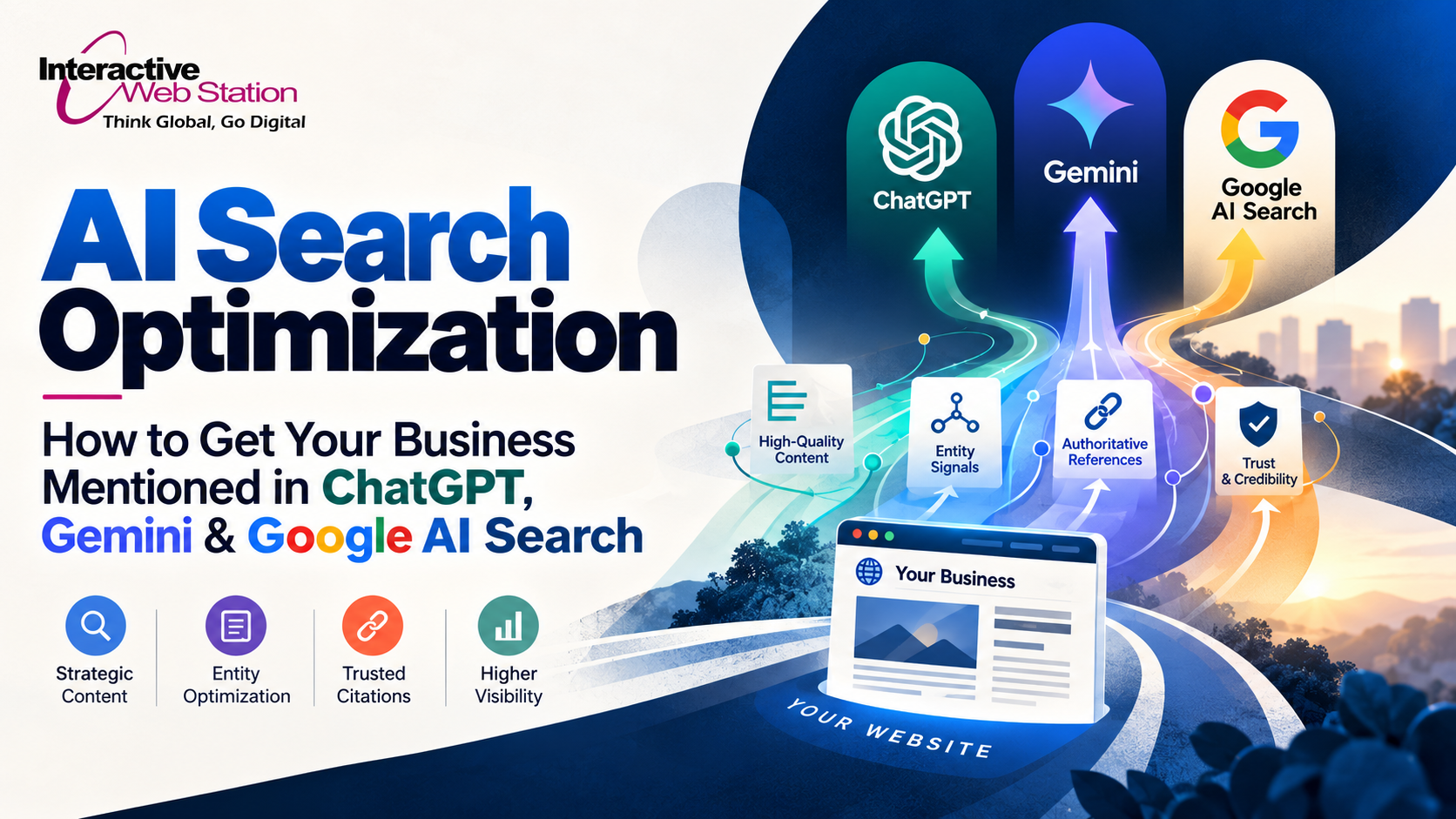
AI Search Optimization: How to Get Your Business Mentioned in ChatGPT, Gemini & Google AI Search
A business can rank well on Google and still disappear when someone asks ChatGPT or Gemini for companies offering the same service.
That does not necessarily mean its SEO has failed.
It means search discovery is becoming broader than the traditional results page.
People are increasingly asking complete questions rather than typing short keywords: “Which company in Vadodara offers this service?”, “Who should I shortlist?”, “What are my options?” or “Which provider has experience with this problem?”
AI-assisted search can answer those questions by combining information from multiple sources instead of sending the user directly to one website.
Traditional SEO still provides much of the foundation. What changes is the problem we are trying to solve.
For AI Search Optimization in Vadodara, the useful question is not:
“How do we optimise a website for ChatGPT?”
It is:
Can search and AI systems find the business, understand what it does, connect it with the right topics, verify important information and find something useful enough to reference?
That distinction makes AI search optimisation far more practical—and far less mysterious.
How AI Search Actually Finds Information
ChatGPT, Gemini, Google AI Overviews and Google AI Mode are often discussed as though they use one universal ranking system.
They do not.
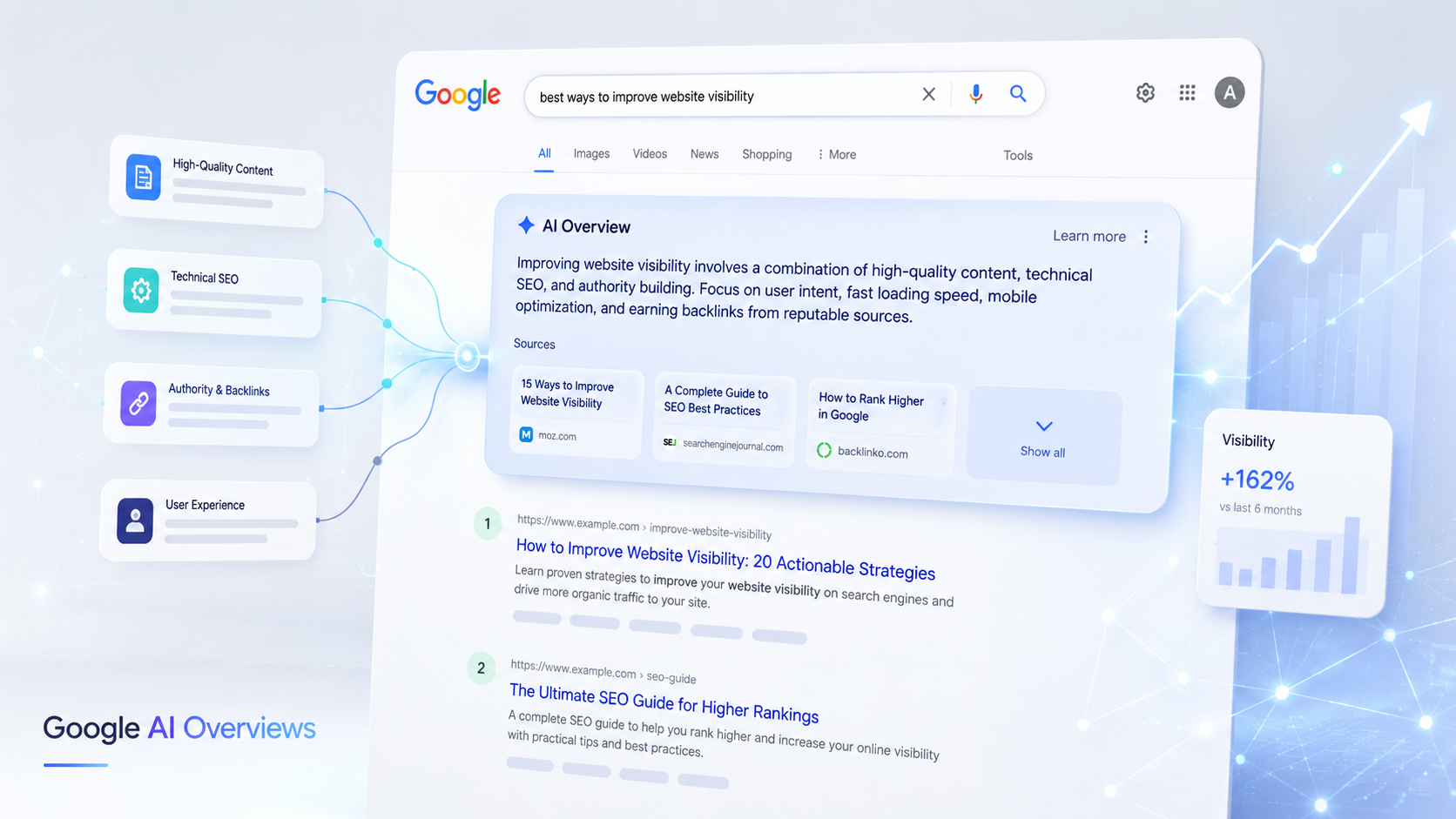
Google says its generative Search experiences still rely on its existing Search infrastructure and ranking systems. For more complex questions, Google can also use what it calls query fan-out, issuing related searches across subtopics and data sources to construct a response.
ChatGPT Search has its own technical considerations. OpenAI identifies OAI-SearchBot as the crawler used to surface websites in ChatGPT’s search features. OAI-SearchBot is separate from GPTBot, which OpenAI uses for content that may contribute to training its generative models. A website can therefore allow one while blocking the other.
For SEO work, I find it more useful to break AI-search visibility into four questions:
| Stage | What to investigate |
| Discover | Can search systems access the important information? |
| Understand | Is it obvious who the business is, what it offers and where it operates? |
| Verify | Are important business and service claims supported consistently? |
| Select | Does the page contribute useful information for the user’s question? |
These are not four official Google ranking factors.
They are a practical diagnostic framework.
And that distinction matters.
Start with accessibility before publishing more content
If an important service page is blocked, poorly linked, incorrectly canonicalised or difficult to render, rewriting its introduction will not solve the underlying problem.
Check the fundamentals first:
- crawl accessibility;
- indexability;
- canonical URLs;
- internal linking;
- meaningful rendered text;
- robots directives;
- response codes;
- server or CDN restrictions.
For ChatGPT Search specifically, OpenAI recommends allowing OAI-SearchBot if you want pages to be eligible to surface in its search results. OpenAI also notes that websites can accidentally block crawlers through firewalls, CDNs and bot-protection systems.
This is where SEO and web development overlap. There is little value in creating excellent content if the systems expected to discover it cannot reliably access it.
Give Search Systems Something Worth Using
Once accessibility is handled, the more difficult question begins:
Why should this page be useful in an answer?
This is where much of the current GEO conversation gets distracted by technical-sounding shortcuts.
Google clarified on June 15, 2026 that llms.txt files are not needed for Google Search and do not positively or negatively affect Search visibility or rankings. Google also said it is fine to maintain such a file for other systems that use it.
So the better use of time is not asking whether another AI-specific file can be added.
Ask whether the content offers information that another page does not.
Twenty agencies can publish an article explaining “What is GEO?”
The twenty-first definition does not automatically add anything useful.
A stronger article might explain:
- how an AI visibility problem was diagnosed;
- which pages were inaccessible and why;
- where business information contradicted other sources;
- why one type of customer query surfaced the company while another did not;
- which assumptions were tested and rejected;
- what changed after the underlying issue was corrected.
That is where actual expertise starts becoming visible.
Answer the problem behind the keyword
A business looking for Generative Engine Optimization Vadodara is unlikely to need another 500-word definition of GEO.
The more useful question is:
What would have to change on our website and wider web presence before search systems can understand our company more clearly?
The same applies to Answer Engine Optimization Vadodara.
Adding dozens of question headings does not automatically create a good AEO strategy.
Answers need to be clear enough to extract, but they also need context, reasoning and evidence.
Short does not automatically mean useful.
Myth vs Reality: AI SEO shortcuts
| Common claim | More accurate interpretation |
| “Google needs llms.txt for AI visibility.” | Google explicitly says it does not. |
| “Special AI schema gets pages cited.” | Google uses structured data to understand information on pages, but structured data does not guarantee inclusion in an AI-generated answer. |
| “Traditional SEO no longer matters.” | Google’s current AI Search guidance continues to build on existing Search systems and SEO foundations. |
| “More AI-written pages create topical authority.” | Publishing volume alone does not establish expertise or usefulness. |
| “There is one ChatGPT ranking to monitor.” | AI responses can vary by question, context and available sources, so a single position is an incomplete measurement model. |
The useful conclusion is not that GEO and AEO are unnecessary.
It is that they should extend sound SEO rather than replace it.
Make the Business Easier to Understand Beyond One Page
Local visibility introduces another problem.
Your service page may describe the company perfectly while the rest of the web provides incomplete, old or inconsistent information about the same business.
That is worth investigating.
For a business working on AI SEO services in Vadodara, review whether the essential facts are consistent across places users and search systems may encounter them:
- company website;
- Google Business Profile;
- relevant business directories;
- professional profiles;
- authoritative industry mentions;
- review platforms;
- team or author profiles.
The objective is not to create dozens of artificial listings.
Interactive Webstation, a Vadodara-based digital marketing and web development company, is one example of a local business that can strengthen its AI search visibility by keeping its services, location, expertise, and supporting brand information consistent across its website and trusted external sources.
It is to reduce ambiguity.
For Google specifically, LocalBusiness structured data can communicate business information such as location and operating details in a machine-readable format. Google describes structured data as a way to provide explicit information about page content; it should therefore match what users can actually see on the page.
Think of this as entity clarity, not a guaranteed AI-ranking trick.
An organisation claiming expertise in AI search should also show evidence wherever genuine evidence exists.
A portfolio containing relevant work is more useful than repeatedly calling the company “leading,” “best,” or “expert.”
Case studies are stronger still when they explain the original problem, the work performed and a verifiable outcome.
If that evidence does not exist yet, do not manufacture it.
Advanced Practitioner: Diagnose the Visibility Failure First
Publishing more content should not be the automatic response every time a company fails to appear in an AI answer.
Diagnose where the problem occurs.
1. Test discovery
Review:
- robots.txt;
- meta robots;
- canonical tags;
- HTTP responses;
- rendered HTML;
- internal links;
- XML sitemaps;
- OAI-SearchBot access where ChatGPT Search visibility matters.
If important pages are difficult to discover, solve that before creating another content cluster.
2. Test entity clarity
Run searches such as:
- brand + service;
- brand + location;
- brand + company category;
- brand + key team member.
This is not a Google-prescribed ranking test.
It is a practical way to expose inconsistent positioning, stale profiles and ambiguous entity information.
3. Test groups of real customer questions
One prompt proves very little.
Instead of repeatedly testing:
“Who is the best AI SEO company in Vadodara?”
build a small prompt set around genuine customer intent:
- AI SEO consultants in Vadodara;
- GEO services in Vadodara;
- company for improving ChatGPT search visibility;
- AEO services for local businesses;
- agency experienced with AI search optimisation.
Then compare the results over time.
Do not keep changing the prompt until your brand appears. That creates a misleading picture.
The useful question is where and why the brand repeatedly fails to appear.
4. Study the cited sources
This is one of the most valuable parts of AI-search competitor research.
When another company appears, inspect what supports it.
Ask:
- Which URL was cited?
- What information does that page contain?
- Is the service described more precisely?
- Does the company have stronger supporting evidence?
- Are independent sources also discussing it?
- Does the cited page contribute information your page does not?
That produces an actionable content gap.
“Competitor X appears in ChatGPT” does not.
5. Measure more than mentions
Traditional rank tracking gives you a fairly familiar metric: position.
AI-assisted discovery needs more context.
A useful measurement framework can include:
- presence across a defined prompt set;
- cited URLs;
- competitor mentions;
- referral traffic from identifiable AI sources;
- enquiries influenced by those visits;
- qualified leads;
- conversions.
Keep those measurements separate.
A brand mention is not automatically a citation.
A citation is not automatically a visit.
A visit is not automatically a qualified lead.
For that reason, AI-search work should sit alongside organic SEO, content, PPC management and other acquisition channels rather than being treated as an isolated marketing system.
FAQs
What is AI Search Optimization?
AI Search Optimization is the work involved in making useful information about a business easier for AI-assisted search systems to discover, understand and retrieve. In practice, it overlaps with technical SEO, content quality, structured information, entity clarity and authority building.
Is GEO different from traditional SEO?
Yes, although there is significant overlap. Traditional SEO primarily focuses on visibility within search-engine results and the traffic that follows. GEO places more emphasis on whether generative systems can retrieve and reference useful information while constructing an answer.
Can an AI SEO agency guarantee a ChatGPT recommendation?
No. An AI SEO agency can improve technical accessibility, content quality and business information, but it does not control ChatGPT’s generated responses. Guaranteed inclusion or recommendation claims should be treated cautiously.
Do I need special schema for AI search?
There is no documented special “AI schema” that guarantees inclusion in AI answers. Use relevant structured data to describe actual page information accurately. Google states that structured data helps it understand page content.
Is llms.txt required for Google AI Overviews?
No. Google says llms.txt is not required for Google Search and does not positively or negatively affect Search visibility or rankings.
What should AI SEO consultants in Vadodara investigate first?
Start with accessibility and indexability. Then examine whether the business and its services are described clearly, whether important facts are consistent, whether the content genuinely answers customer questions, and which sources AI-assisted search results currently reference.
Final Thoughts
The wrong way to approach AI Search Optimization is to assume that every new search interface needs a completely new bag of tricks.
Start with a simpler test.
Can the business be found?
Can its services be understood without guesswork?
Are the important facts consistent?
Does its content answer questions that prospective customers actually ask?
And when a competing source is chosen instead, can you identify what useful information that source provides?
Those questions produce work you can act on.
The goal is not to optimise for one chatbot.
It is to build a clearer, better-supported web presence that remains useful whether a customer discovers the business through a traditional Google result, an AI-generated answer, or a cited source.